When we gathered last January for the 8Letters book club session featuring Che de Leon’s Silence, I expected a thoughtful discussion. What I didn’t expect was how quickly the room would shift from a simple author Q&A into a layered, vulnerable exploration of what silence means in a world that demands constant noise. Sitting there, listening to Che speak with such clarity and honesty, the conversation stretching far beyond the novel’s pages and into the lived experiences of everyone present.
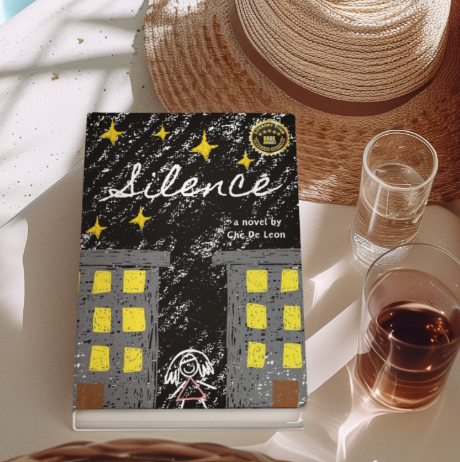
What is the Novel, Silence, about? Here’s the Blurb:
Trapped in a society where only perfection was accepted, Lily had lost her tongue. One day, a girl in a pink and green sweater appears on her doorstep, dangling an offer that she cannot refuse. To get her life back, Lily follows Sweater Girl to the middle of the unforgiving City on the mountains. Haunted by the memories of happier days, she must overcome all odds in order to reclaim her missing tongue–and end her silence.
Literary Titan rated the novel a whopping five stars!
Silence, by Che De Leon, is a gripping dystopian novel set in a world where society is starkly divided into the Complete and the Incomplete. The chasm between these two groups has never been wider, with desperation and greed ruling the day. The black market thrives, as the wealthy treat body parts like fashion accessories, swapping them at will. Amidst this chaotic world, we meet Lily—the girl with no tongue. In this brutal reality, De Leon explores the fragility of humanity. Can a world built on violence, theft, and survival possibly change? Is there room to dream of something better, or is hope a luxury no one can afford? These questions are at the heart of Lily’s journey, as she navigates a life torn between the past and the present.
One of the first questions asked during the session was whether Silence was meant to comment on the digital age’s obsession with visibility. “When I wrote Silence, social media was so far from my mind,” she said. “All I wanted was to tell the story of a girl who has trouble communicating.”
Not every story born in our hyperconnected era is a reaction to it. Sometimes, a story is simply a reaching out, a hand extended from one lonely place to another. The author spoke openly about writing from a neurodivergent perspective, about navigating a world built for neurotypicals where even simple emotions become complicated terrain. “Sometimes you say, ‘I’m sad,’ but how do you really know how sad the person is?” she asked.
Silence as Punishment, Silence as Power
When the conversation turned to how silence functions today versus in past generations, Che’s insight was that, “In the past, silence was seen as limiting, as punishment,” she said. “But today, silence can be weaponized. You can regain your power through silence.”
Another striking moment came when Che reflected on the difference between being silenced and choosing silence.
“Being silenced is when your agency is taken away. But being silent, that’s different. That’s a choice.”
The book’s protagonist, Lily, isn’t passive. It’s shaped by trauma, yes, but also by discernment, self‑protection, and eventually, self‑possession.
The discussion widened to broader societal issues, from the impact of social media to the complexities of global conflicts such as the Israeli-Palestinian conflict. Silence isn’t just a novel about a girl who struggles to communicate. It’s a mirror held up to the ways we navigate a world overflowing with noise, expectation, and misunderstanding. It asks us to consider what we say, what we withhold, and why.
As the discussion moved deeper into the emotional and cultural layers of Silence, another member, Alvin brought up Nick Joaquin’s The Woman Who Had Two Navels, a novel that uses silence to expose the wounds of colonial trauma and fractured identity.
“When it comes to cultural trauma, I guess now that I’m thinking about it, maybe I was informed by it. Because in the Philippines, we have only known defeat.”
Che spoke of a nation that has been repeatedly invaded, colonized, and forced into submission, a people who learned, generation after generation, that survival often meant staying quiet.
“We’ve only ever known that we lost,” she said. “Maybe if we become quiet, we don’t get hurt. Maybe if we just accept it, we don’t get hurt.”
A Character Shaped By Quiet Inheritance
Mitchie added another layer to the conversation, reflecting on Lily’s voice in the novel.
“What I really like about Silence was the character arc,” she said. “In my head, I pictured the protagonist’s voice to be small, tiny, soft, somehow childlike.”
Lily’s softness isn’t a weakness. Lily’s softness is a result of a world that has taught her to be cautious. Even if the author didn’t consciously write Lily as a product of historical trauma, the parallels were unmistakable. Lily’s quietness is not just personal. It is generational. She admitted she had never explicitly connected her narrative to colonial trauma, yet the connection revealed itself naturally through conversation.
In Conclusion
The discussion made me realize that writers often carry their histories in their bodies, in their instincts, in the stories they feel compelled to tell. Sometimes, the page knows before the writer does.
In Silence, the quiet is not empty. It is layered with memory: personal, cultural, ancestral. It conceals, yes. It preserves. And in many ways, it transforms.